
🗺️ This article is part of the Tien Thanh Travel Guide cluster.
Bringing your own vehicle to NovaWorld Phan Thiet makes the drive there and any trips outside the resort much easier. But inside the resort, your own car isn't always the fastest option, and there's one thing related to salt air that few people think about when parking near the sea all day.
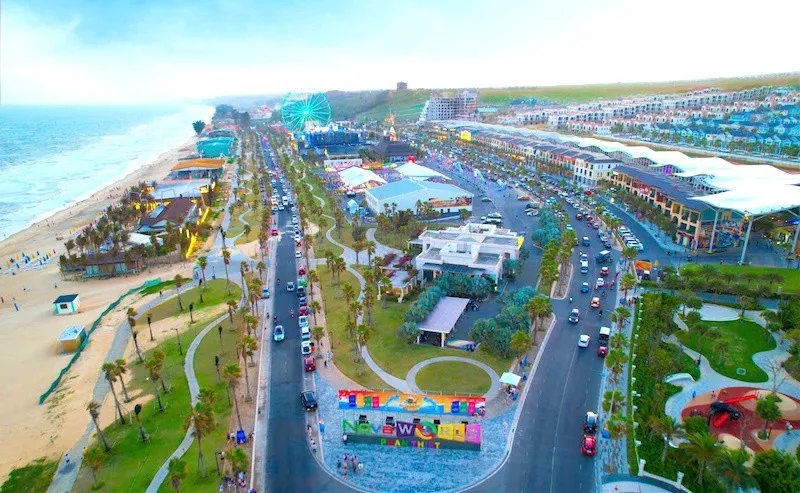
What kind of road runs through the resort, and who shares it
The photo above shows the most important thing: the main route is a multi-lane avenue, and on it cars and the internal shuttle share the same lanes. This isn't a small internal road inside a residential area, nor is it an ordinary public street.
Because there's a walking path on the median, pedestrians — including children — will cross traffic lanes to reach or leave that path. Combined with the shuttle stopping suddenly to pick up passengers, this is why it's worth driving slower than the road width suggests. The layout of the different types of paths is covered in our internal walking map.
Four different parking situations
Parking inside the resort isn't one thing — it's four, and each has its own approach.
| Situation | What to know |
|---|---|
| Parking at your accommodation | Villas and townhouses usually have space within the property line. Ask how many vehicles it fits — a question people often forget when traveling with several cars in a group. |
| Parking when visiting an amenity | Ask ahead where parking sits relative to the entrance. On busy days, spots near the gate fill up first, so factor in the walk from your car to the gate. |
| Parking for a quick meal | Many eateries line the shophouse row. Curbside parking requires watching for signage and not blocking another unit's exit. |
| Parking all day to walk or use the shuttle | This is the most sensible way to use your car inside the resort — but if the spot is outdoors near the sea, see the section below on salt air. |
When to drive inside the resort, when to leave the car
The simple rule: use your car for getting in and out of the resort; inside, walk or use the shuttle. The reason isn't that the roads are hard to drive — it's the layout.
- The trip to and from the resort
- Heading outside the resort: up to Mui Ne, down to Ke Ga, dining out
- Carrying lots of gear, or traveling with someone who has trouble walking
- Traveling during harsh sun or rain
- Short trips along the main road — finding parking often takes longer than walking
- Dinner at the shophouse row
- Heading to a beach right near your accommodation
- Traveling as a full group — one shuttle is simpler than splitting into several cars
If you're coming from Ho Chi Minh City, route and cost details are in our getting-there and cost guide. Our Lac Long Quan road guide covers the coastal corridor south of the city, which is the route you'll take heading outside the resort.
A car parked all day at the beach: what to do
Few people think about this, and it shares the same cause as maintaining a beachfront home: sea wind carries salt, and salt on metal surfaces absorbs and holds moisture. This mechanism is explained in our guide to maintaining a beachfront villa — and it applies to cars just as much as houses.
If you don't bring your own vehicle
You can still get around fine without one, and for some kinds of trips, it's actually easier.
Frequently asked questions
Yes, if you're planning to go outside the resort — up to Mui Ne, down to Ke Ga, or dining out. If the trip stays entirely inside the resort, the shuttle plus walking is enough, and finding parking for a short trip often takes longer than the trip itself.
Two things: the shuttle shares the lane and stops suddenly to pick up passengers; and there's a walking path on the median, so pedestrians cross traffic at points that aren't marked crossings. The wide road surface can also tempt you to drive faster than you should.
Ask ahead where parking sits relative to the entrance. On busy days, spots near the gate fill up first, so factor in the walk from your car — this matters especially if you're traveling with young kids or older relatives.
Yes. Sea wind carries salt, and salt on metal absorbs and holds moisture — the same mechanism that makes beachfront homes need more maintenance. The simple fix: prioritize a covered spot, and wash the car after a beach trip instead of waiting for a routine wash, paying attention to the underside.
Villas and townhouses usually have space within the property line, but how many vehicles fit varies by unit — worth asking specifically, especially if your family has two cars or you often travel with a group with multiple vehicles.
Inside the resort, the shuttle is simpler — splitting into multiple cars means multiple parking searches and a group that easily gets separated. For getting in and out of the resort, use your own vehicle. How to divide tasks for a large group is in our guide for groups of 8–12.
- The multi-lane avenue, cars and shuttle sharing traffic, and the median walking path: direct observation from the aerial photo in this article.
- The mechanism by which salt air accelerates metal corrosion (salt absorbs moisture and keeps surfaces continuously damp) is a general characteristic of coastal environments.
- This article doesn't cite specific parking regulations, fees, or per-unit parking counts — please confirm directly.
Article compiled on 30/7/2026.
Read more
More from the travel guide
Need a place to stay for this trip?
Whole-villa rentals inside NovaWorld — private pool, kitchen, BBQ garden. Rates straight from the operator, availability updated in real time.