
🏖️ This article is part of the Phan Thiet – Mui Ne Travel Guide cluster.
1. A Final Verse from a Golden Kingdom
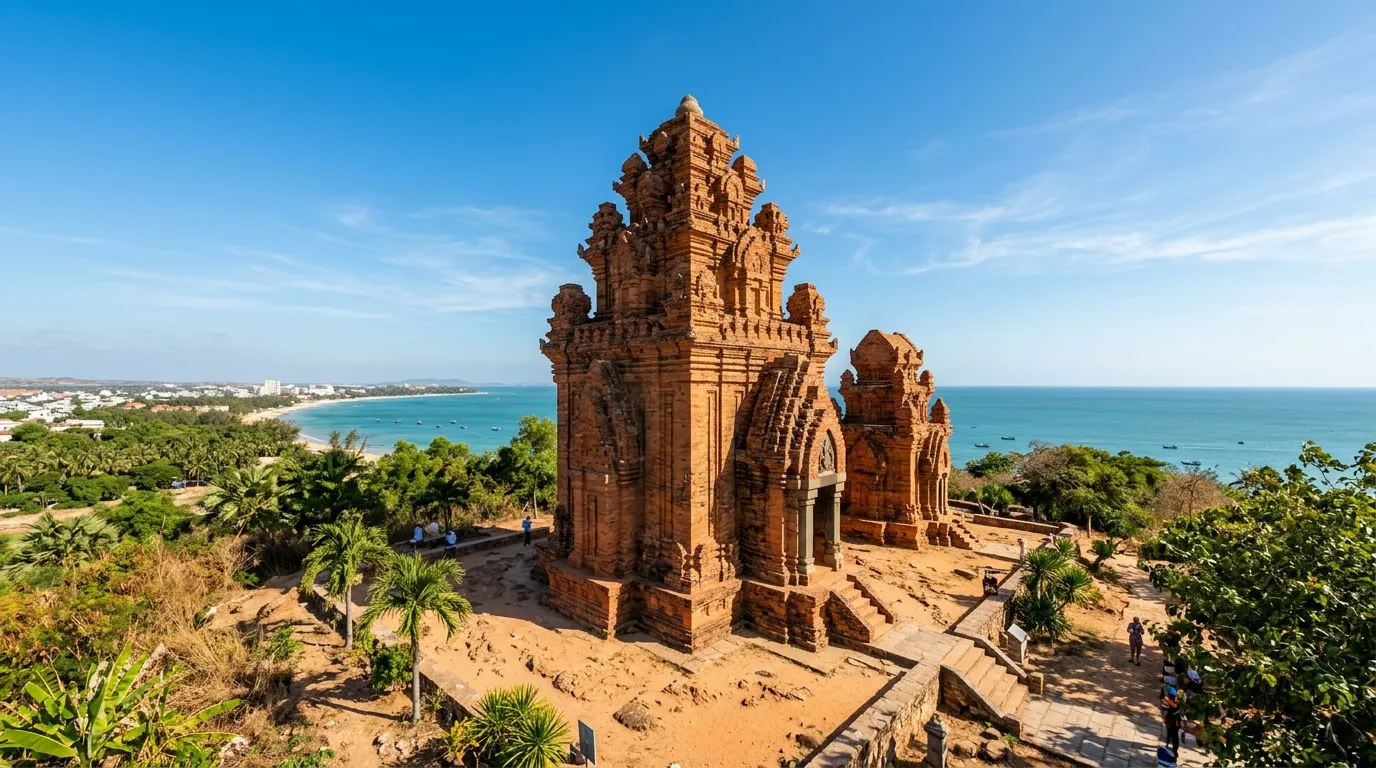
Standing proudly atop windswept Ba Nai Hill, about 7 km northeast of central Phan Thiet, the Poshanu Cham towers rise as a quiet witness to history, holding the vivid memory of the ancient Champa Kingdom. As the first rays of dawn touch the reddish fired brick, or as sunset paints the whole sky in fiery silk, Poshanu takes on a beauty that's both mysterious and breathtakingly majestic.
Unlike the lively, bustling beaches of Mui Ne, the Poshanu Cham Towers carry a quiet, sacred tone. Wind whistling through cracks in the brick, the distant murmur of the sea — together they form an endless duet of time and space. Visiting Poshanu isn't just a sightseeing stop — it's a journey back through history, a chance to touch the past and feel the cultural depth of a people who once ruled this sun-and-wind-swept central coast.
The towers were built between the late 8th and early 9th centuries, in the Hoa Lai architectural style — one of the oldest and most refined artistic styles of the Cham people. Originally, the complex was built to worship Shiva, one of Hinduism's supreme deities, symbolizing destruction and rebirth. By the 15th century, the Cham added smaller shrines to honor Princess Poshanu — the talented, virtuous daughter of King Para Chanh, credited with teaching the people farming, weaving, and animal husbandry.
2. Hoa Lai Architecture — the Best-Preserved Cham Tower Group
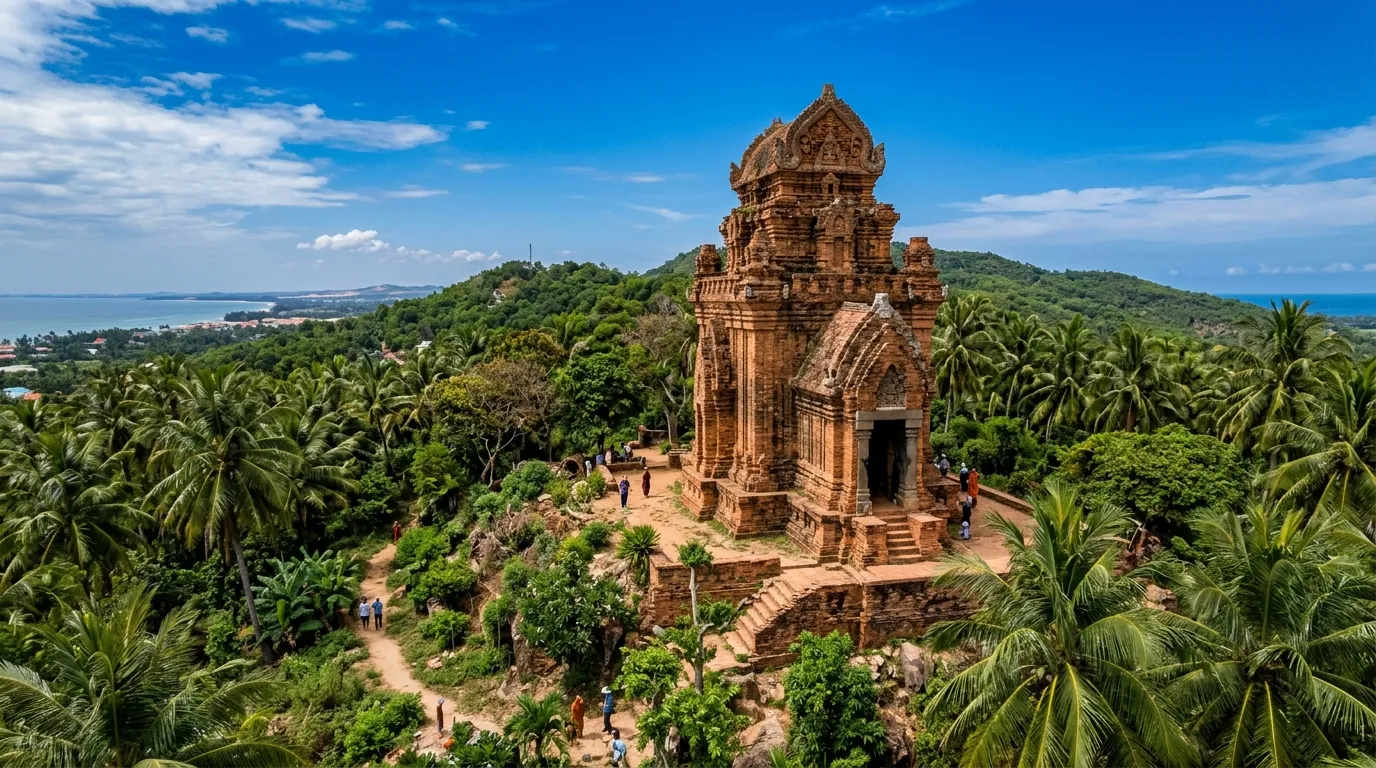
What makes the Poshanu Cham Towers so captivating is a unique architectural art form that scientists still haven't fully decoded. From a distance, the towers look like giant torches reaching into the deep blue sky. Up close, the intricate carved details are what truly leave visitors in awe.
Three main towers remain today: Tower A (the main tower), Tower B (a secondary tower), and Tower C (the gate tower). Tower A is the tallest, at about 15 meters, with three tiers of roofing that narrow toward the top. Its main entrance faces east — the direction of life and the gods in Cham belief. Inside the main tower, a Linga-Yoni altar carved from a single block of green stone still remains, symbolizing fertility and the union of yin and yang.
The building technique of the ancient Cham at Poshanu is a true masterpiece. Fired red bricks of remarkably uniform size are stacked so tightly you couldn't slide a blade between them. Curiously, no trace of any binding material like mortar or modern cement has ever been found. Researchers believe the Cham either used a special tree resin, or fired the bricks in place so they fused directly to each other.
Beyond its construction technique, the Poshanu towers also impress with intricate decorative details. Doorway arches curve in soft, flowing lines, carved with floral motifs, birds, and Apsara dancers lost in a sacred dance. Though time and the ravages of war have worn away much of the detail, what remains is proof enough of the skill and creative genius of ancient Champa artisans.
Standing at the foot of the towers, looking up at their peaks rising into the sky, you'll feel how small a person is against such a monumental structure and the vastness of time — a feeling that's part awe, part reverence, and quietly cleansing.
3. The Sad Love Story of Princess Poshanu
Beyond its architectural beauty, the Poshanu towers are tied to a sorrowful yet romantic love story between Princess Poshanu and Lord Po Sahmeng. Legend has it that Princess Poshanu was a woman of great beauty and intelligence, who fell in love with Po Sahmeng, a Muslim lord from the Ma Lam region.
Their love faced fierce opposition from the Champa royal court and nobles over their religious differences. Yet through fierce devotion and determination, the two eventually overcame every obstacle to be together. They lived happily, touring the land together and teaching people how to farm, weave, and fish.
But their happiness was short-lived. Princess Poshanu's brother, unwilling to accept a sister married to someone of another faith, schemed to drive the two apart. While Po Sahmeng was away, the brother tricked him into believing the princess had betrayed him. Devastated, Po Sahmeng left for the south.
When Princess Poshanu learned what happened, she traveled far to find her husband and explain. But when she arrived, she found Po Sahmeng living happily with a new wife, a Raglai princess. Heartbroken, Princess Poshanu wiped away her tears and returned home. She spent her final years in quiet solitude at this temple complex, devoting herself entirely to teaching her people.
After her death, in tribute to her virtue and sacrifice, the Cham named the temple complex after her — Poshanu — and began worshipping her here. Her sorrowful love story adds a layer of quiet romance to the towers, and stands as a testament to the human longing for free love, beyond the prejudices of its time.
4. Experiences Worth Trying at Poshanu
A visit to the Poshanu Cham Towers isn't complete with just admiring the architecture. This site offers other experiences that deepen your understanding of Cham culture and history.
4.1. Chase a Stunning Sunset on Ba Nai Hill
Ba Nai Hill, home to the towers, is one of the best sunset-viewing spots in Phan Thiet. As the sun sinks into the sea, golden-orange light streams slanting through the towers' arched openings, creating a magical lighting effect. The scene is both majestic and poetic — a memory you won't forget. Bring a camera and find your favorite angle to capture this golden moment.
4.2. Explore Lau Ong Hoang — a Trace of Poet Han Mac Tu's Love Story
Not far from the Poshanu towers, also on Ba Nai Hill, are the ruins of Lau Ong Hoang, a French-style structure built in the early 20th century. Though only crumbling walls remain today, Lau Ong Hoang still draws visitors for its romantic yet tragic love story between poet Han Mac Tu and poet Mong Cam. Standing at Lau Ong Hoang, you can look out over a full view of gentle Phan Thiet city against the deep blue coastline.
4.3. Join the Kate Festival with the Cham Community
If you visit around the 7th month of the Cham calendar (usually falling in September or October), you may catch the Kate Festival — one of the largest and most important festivals of the Brahmanist Cham community. It's an occasion for the Cham to honor their deities, kings, and ancestors who contributed to their people.
During the festival, the Poshanu towers come alive with color, as people gather in vibrant traditional dress, the sound of the saranai horn and ginang drum filling the air. You'll witness unique traditional rituals like the procession of royal garments, the bathing of statues, and — most captivating of all — the graceful, mesmerizing Apsara dances. It's a wonderful opportunity to learn about and experience the distinctive culture of the Cham people.
5. Practical Tips for Your Visit
For a complete and meaningful visit to the Poshanu Cham Towers, keep the following in mind:
What to wear: Since this is a sacred historical and religious site, dress modestly and avoid overly short or revealing clothing. Wear flat shoes or sneakers for easy movement on the hill.
The best time to visit: Visit early in the morning (7:00–9:00am) or in the late afternoon (3:30–5:00pm) to avoid the harsh central-coast sun. These are also the two windows with the best light for photography.
Respecting the heritage site: The Poshanu towers are a precious cultural heritage that deserves preservation. Please don't climb on the structures, write or draw on the walls, or litter. Be a considerate visitor and help preserve this site's beauty for future generations.
Pairing with nearby destinations: Your trip will be richer if you combine a visit to Poshanu with other well-known Phan Thiet destinations like Ong Dia Rock Beach, Fairy Stream, the Sand Dunes, or the Mui Ne Fishing Village. They're all along the same route, making it easy to visit several in one trip.
The Poshanu Cham Towers aren't just an ancient architectural landmark — they're a living history book, telling the story of a glorious era of the Champa Kingdom. The towers' quiet, solemn beauty set against the vast sky, together with their legendary stories, will leave a deep and lasting impression on every visitor.
Read more
More from the travel guide

The Complete Self-Guided Mui Ne Travel Guide 2026
The complete 2026 self-guided Mui Ne Phan Thiet travel guide: getting there by expressway, the…

Bau Trang Mui Ne: A Complete Guide to Vietnam's Little Sahara (2026)
A complete Bau Trang Mui Ne travel guide: renting an off-road ATV, jeep tours up the dunes, ka…
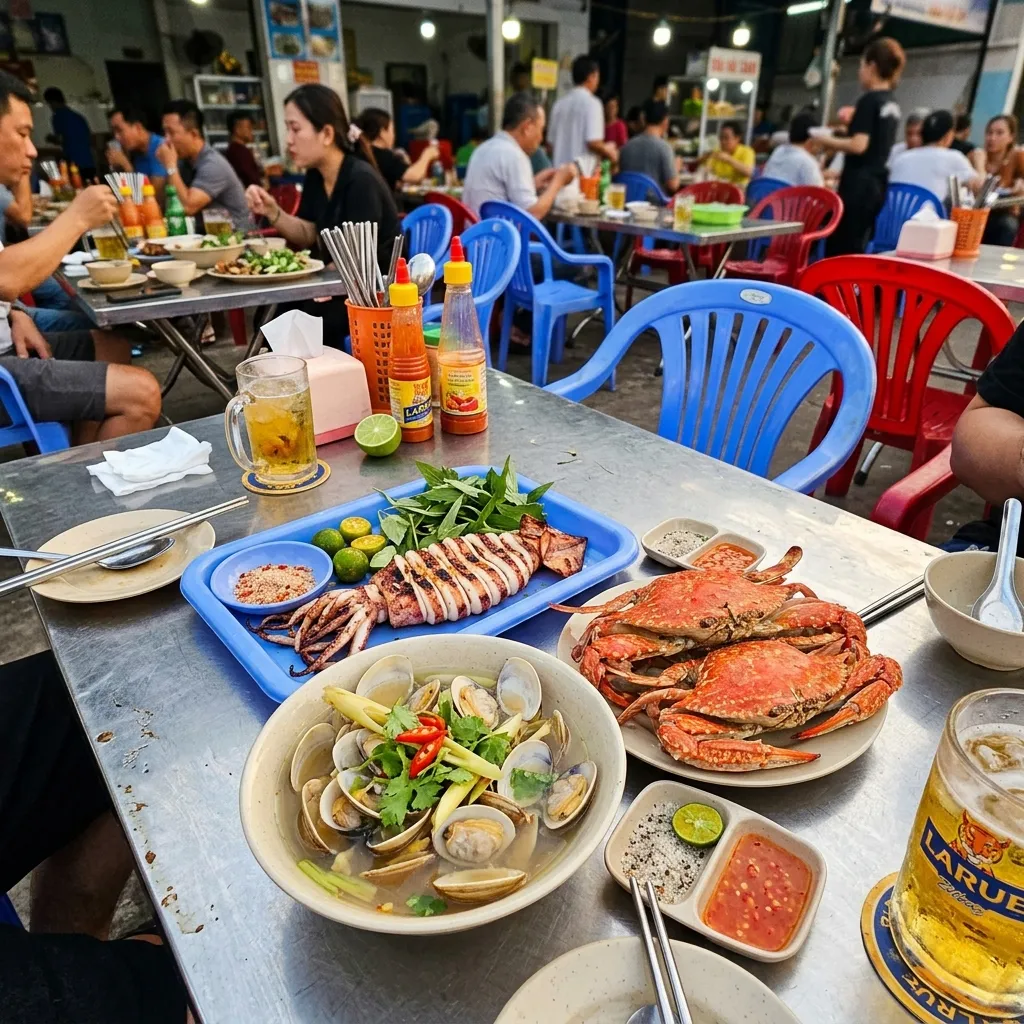
Top 10 Best Affordable Seafood Restaurants in Mui Ne (2026 Prices)
An honest review of the top 10 affordable, quality seafood restaurants in Mui Ne Phan Thiet. E…
Need a place to stay for this trip?
Whole-villa rentals inside NovaWorld — private pool, kitchen, BBQ garden. Rates straight from the operator, availability updated in real time.